Asteroids is an arcade space shooter released in November 1979 by Atari, Inc. and designed by Lyle Rains, Ed Logg, and Dominic Walsh. The player controls a spaceship in an asteroid field which is periodically traversed by flying saucers. The object of the game is to shoot and destroy asteroids and saucers while not colliding with either or being hit by the saucers' counter-fire. The game becomes harder as the number of asteroids increases.
Asteroids was one of the first major hits of the golden age of arcade games. The game sold over 70,000 arcade cabinets and proved both popular with players and influential with developers. It has since been ported to multiple platforms. Asteroids was widely imitated and directly influenced Defender, Gravitar, and many other video games.
Arcade, Atari 2600, Atari 7800, Atari 8-bit Atari Lynx, Atari arcade, asteroids game, Playstation, Nintendo 64, Windows, Game Boy Color, Xbox , Playstation 2, atari 800 games, atari asteroids game.
Why Bennu? - OSIRIS-REx Mission Who Named Asteroids
How was Bennu chosen?
The goal of the OSIRIS-REx mission is to collect a sample from an asteroid and bring it back to Earth. But just how did the OSIRIS-REx team choose Bennu from the over 500,000 known asteroids in the Solar System?
Proximity to Earth
The closest asteroids to Earth are called Near-Earth Objects (NEOs). As the name suggests, NEOs are objects that orbit within 1.3 AU of the Sun. (1 AU = the distance between Earth and the Sun, or ~93 million miles) For a sample return mission like OSIRIS-REx, the most accessible asteroids for a spacecraft to reach are located between 1.6 AU and 0.8 AU. The ideal asteroid has an Earth-like orbit with low eccentricity and inclination. At the time of the mission’s asteroid selection in 2008, there were over 7,000 known NEOs, but only 192 had orbits that met these criteria.
Size
Asteroids with small diameters rotate more rapidly than those with large diameters. With a diameter less than 200 meters, an asteroid spins so rapidly that the loose material on its surface (regolith) can be ejected from it. The ideal asteroid has a diameter larger than 200 m so that a spacecraft can safely come into contact with it and collect a sufficient regolith sample. This size requirement reduced the number of candidate asteroids from 192 to 26.
Composition
Asteroids are divided into different types based on their chemical composition. The most primitive asteroids are carbon-rich and have not significantly changed since they formed nearly 4 billion years ago. These asteroids contain organic molecules, volatiles, and amino acids that may have been the precursors to life on Earth. Of the 26 asteroids left on the list, only 12 had a known composition, and only 5 were primitive and carbon-rich.
From these 5 asteroids, Bennu was selected. Bennu is a B-type asteroid with a ~500 meter diameter. It completes an orbit around the Sun every 436.604 days (1.2 years) and every 6 years comes very close to Earth, within 0.002 AU. These close encounters give Bennu a high probability of impacting Earth in the late 22nd century. Bennu’s size, primitive composition, and potentially hazardous orbit make it one of the most fascinating and accessible NEOs … and the ideal OSIRIS-REx target asteroid.
The Asteroid 5 Astraea - In-The-Sky.org Asteroid 5 Astraea
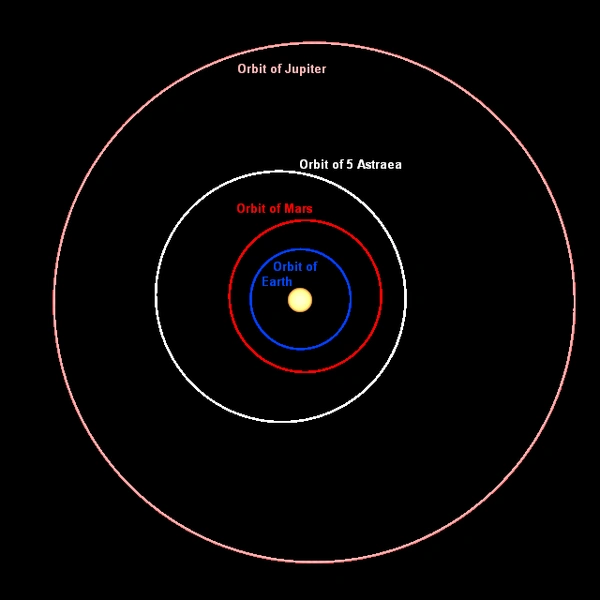
The asteroid 5 Astraea
Finder chart
Please wait
Loading 0/4
Click and drag to rotate
Mouse wheel to zoom in/out
Touch with mouse to dismiss
Click and drag the chart above to pan around the sky, or use the mouse wheel to zoom.
.
From Bandung ,
5 Astraea will become visible around 18:36 (WIB) as the dusk sky fades, 62° above your northern horizon. It will then sink towards the horizon, setting at 00:22.
Asteroid Database And Mining Rankings How Much Asteroids Are There
Asterank is a scientific and economic database of over 600,000 asteroids.
We've collected, computed, or inferred important data such as asteroid
mass and composition from multiple scientific sources. With this information,
we estimate the costs and rewards of mining asteroids.
Details on orbits and basic physical parameters are sourced from the Minor
Planet Center and NASA JPL. Composition data is based on spectral
classification and size. Our calculations incorporate conclusions from
multiple scientific publications in addition to cross-referencing known
meteorite data.
Asteroids In Collision: A New Model How Asteroids Work
If we were to find an asteroid on a trajectory to impact the Earth, what strategies would we use to stop it? Recent work from Johns Hopkins University shows that there is a wide range in our thinking on what happens to asteroids under various mitigation scenarios. Much depends, of course, on the asteroid’s composition, which we must account for in our models. A good thing, then, that we are supplementing those models with sampling missions like OSIRIS-REx and Hayabusa-2.
Let’s look at the JHU work, though, which updates earlier results from Patrick Michel and colleagues, reported in a 2013 paper; the latter had considered the 5 km/s head-on impact of a 1.21 km diameter basalt impactor on a 25 km diameter target asteroid, with a model varying mass, temperature and material brittleness. Michel’s work showed evidence that the asteroid being targeted would be completely destroyed by the impactor. What Charles El Mir and colleagues at Johns Hopkins have been able to show is that other outcomes are likely.
“We used to believe that the larger the object, the more easily it would break, because bigger objects are more likely to have flaws,” says El Mir. “Our findings, however, show that asteroids are stronger than we used to think and require more energy to be completely shattered.”
Using essentially the same scenario as Michel, El Mir, K. T. Ramesh (JHU) and Derek Richardson (University of Maryland) have created a new model that offers a more detailed look at the smaller-scale processes that take place during such a collision. “Our question was, how much energy does it take to actually destroy an asteroid and break it into pieces?” adds El Mir.
Discussing methods, the authors note their model’s calculation of the first tens of seconds following impact, with transition to computer code integrating longer-term effects. From the paper:
The multi-physics material model is centered around the growth mechanism of an initial distribution of subscale flaws. Rate effects in the model are a natural outcome of the limited crack growth speed, which is explicitly computed based on the local stress state. In addition, porosity growth, pore compaction, and granular flow of highly damaged materials are captured at the material-point level. We validated the model’s predictive capability by comparing the dynamic tensile strength with high-strain-rate Brazilian disk experiments performed on basalt samples.
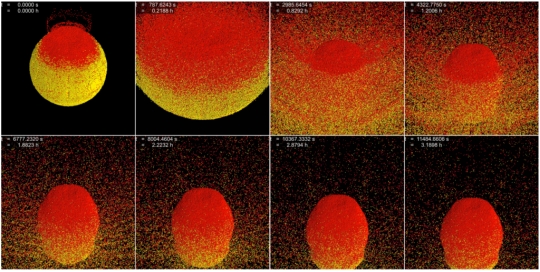
Image: A frame-by-frame showing how gravity causes asteroid fragments to reaccumulate in the hours following impact. Credit: Charles El Mir/Johns Hopkins University.
The first phase of the scenario is shown in the video below, available at for email subscribers who would like to follow it up in their browsers. What emerges is that millions of cracks form in the asteroid as the crater is created, with the asteroid surviving the hit rather than being shattered, while the surviving core then has sufficient gravitational pull to act on the fragments swirling around it.
In the second phase, available at , what we have left is not a rubble pile held loosely by gravity, but rather a surviving core whose fragments have been redistributed. Can we, then, hope to break an asteroid into small pieces, or is it best to find ways to nudge the entire object onto a new trajectory? The latter still involves the question of asteroid survivability, as we need to move it without breaking it into smaller impactors.
The paper shows the capability of the parent asteroid to withstand huge shock:
The collision imparted substantial damage onto the target, with most of the damage localized under the impact site, resulting in a heavily fractured but not fully damaged “core”. The material points were then converted into soft spheres and handed over to pkdgrav [the modeling software] in a self-consistent manner to calculate the gravitational interaction of the ejected material. We observed substantial ejecta fallback onto the largest remnant of the parent body, with a recovered mass of the largest remnant being 0.85 that of the parent body, indicating that the disruption thresholds for such targets may be higher than previously thought.
Thinking ahead to asteroid mitigation strategies is simple prudence, and requires continuing study of how asteroids respond to the various methods now under consideration to destroy them or change their trajectory. This paper gives us a glimpse of the changing parameters of research on the matter, a window into the ongoing analysis that will refine our planning.
The paper is El Mir et al., “A new hybrid framework for simulating hypervelocity asteroid impacts and gravitational reaccumulation,” Icarus Vol. 321 (15 March 2019), pp. 1013-1025 ().